
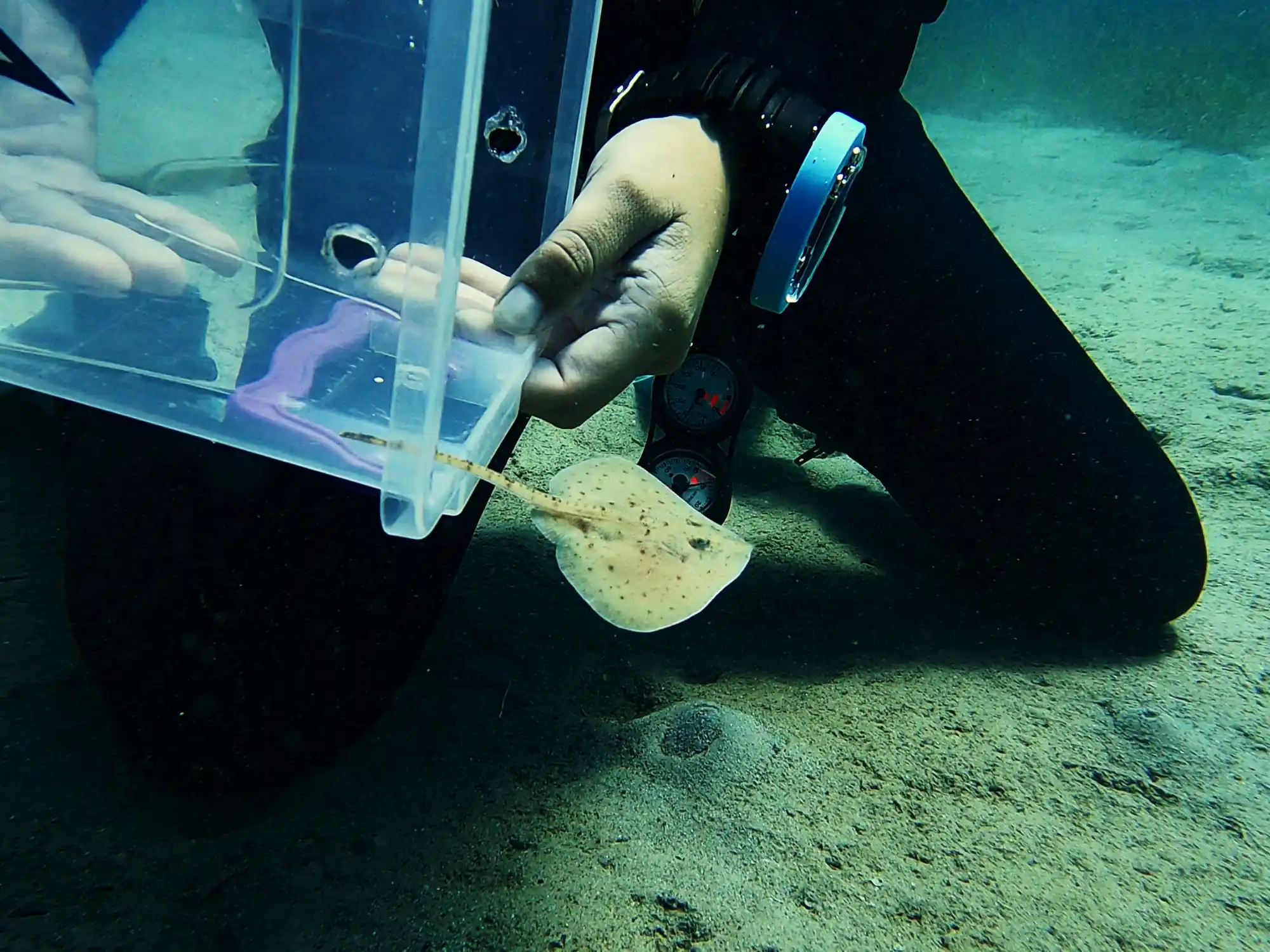
First successful Thornback ray hatching within the framework of the ”Thermaikos Biodiversity Project”
Monday, 29 September 2025
For the first time in Greece, within the framework of the Thermaikos Biodiversity Project, implemented by the environmental organisation iSea and the Sani/Ikos Group, a Thornback Ray, a vulnerable ray species, was successfully hatched and released into the sea. This achievement holds significant scientific importance, as it represents only the second recorded hatching of the species in a controlled environment across the entire Mediterranean.
According to the Greek Red List of Threatened Species, nearly half of the country’s ray species are at risk of extinction, with bycaught being their primary threat. Similarly, their egg cases often accidentally caught in fishers’ nets, leaving limited chance of survival for the embryos.
To address this challenge, within the framework of the Thermaikos Biodiversity Project, iSea and the Sani Resort of the Sani/Ikos Group have been working closely for the past two years with fishers from Halkidiki and the Thracian Sea. The ray eggs bycaught in their nets are safely release and delivered to iSea, which transfers them to a specially designed aquarium at Sani Resort. There, under controlled conditions, the embryos are given a second chance.
Within this framework, a 6-centimeter egg developed into a 10.5-centimeter ray and was released into its natural environment, where it can grow up to 80 centimeters. This success not only marks the return of a Thornback ray to its natural environment, but also represents a significant step toward 1ex situ conservation of threatened species in Greece.
The initiative was supported by the expertise of the Spanish organisation Associació Lamna, iSea’s partner, which has developed similar protocols for hatching eggs of threatened ray species in the Mediterranean. The “journey” from the release and delivery of the egg by the fisher to iSea, to the release of the newborn ray into the sea, was a continuous process of research, identifying optimal conditions, and refining hatching protocols, which will now serve as a pilot for the future actions of the project. With the power of collaboration and the experience gained by iSea, the journey toward enhancing knowledge and protecting biodiversity continues.
The project is part of the broader development of the Thermaikos Biodiversity Project, which was initially launched in 2021 by iSea and the Sani/Ikos Group as the Thermaikos Dolphin Project, aiming to monitor dolphin populations in the region through photo-identification and to create species-specific catalogs. Today, the project has expanded to include actions for the protection of marine biodiversity, the restoration of threatened ray populations, and the awareness-raising of local communities and visitors.
The Sani/Ikos Group, which hosts the project at Sani Resort and actively supports it, systematically collaborates with scientific institutions, organisations, and local communities, contributing to the protection and regeneration of vulnerable Mediterranean ecosystems as part of its sustainability strategy.
More information about the Thermaikos Biodiversity Project, here.
More about the Sani/Ikos Group’s sustainability and environmental protection initiatives, here.
Watch the video of the first successful hatching in a controlled environment and release of a Thornback ray into the sea here.
1 Protection of species outside their natural habitat.

