
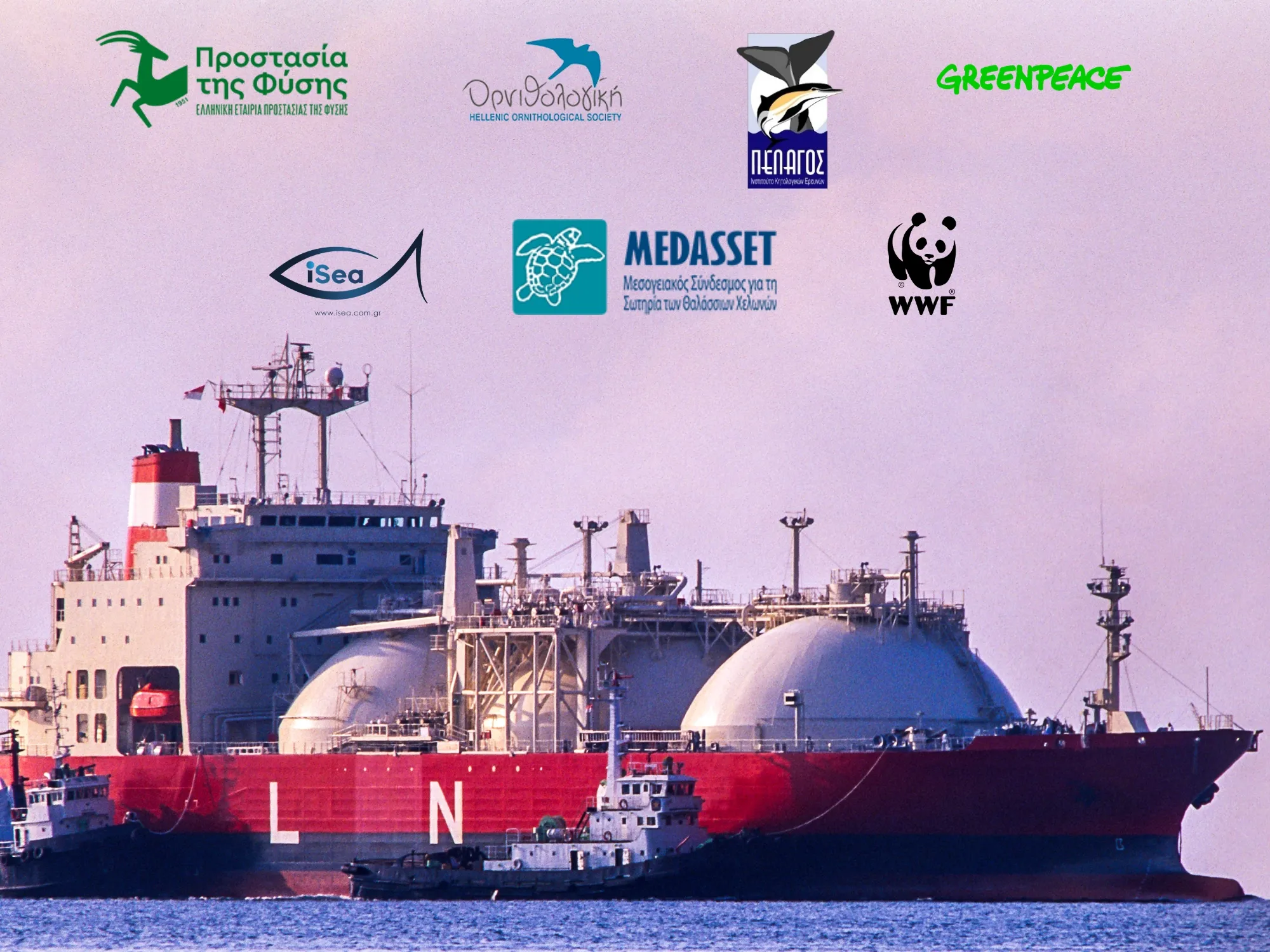
Legal action challenging the second LNG terminal within Greek marine “protected” area
Seven civil society organizations have petitioned the Greek supreme court to annul the environmental permit for the Thrace floating LNG terminal, a high climate emissions and risk offshore Seveso facility (an industrial site handling dangerous substances, governed by EU Directive 2012/18/EU to prevent major accidents) set to operate within a Natura 2000 site.The case underscores the substantial risks linked to fossil gas projects, including methane leaks, fires, and explosions, as well as severe impacts on fisheries and marine ecosystems—ultimately jeopardizing both climate and biodiversity objectives.
In their petition filed before the Council of State, the environmental organisations Hellenic Society for the Protection of Nature, Hellenic Ornithological Society, Pelagos Cetacean Research Institute, Greenpeace Greece, iSea, MEDASSET, and WWF Greece request the revocation of the environmental permit for the Thrace FSRU.
Given that the new Thrace LNG terminal is the second “environmental bomb” located within the same marine Natura 2000 site, seven environmental organizations are calling on the country’s supreme judges to seriously consider the grounds for annulment and to rule based on the grave risk posed both to the national System of Protected Areas and to the implementation of the country’s commitments to the EU’s energy and climate policies.
The main grounds cited in the annulment application, which are of critical environmental and social importance, are as follows:
- Failure to address the methane emissions thus violating article 13 of Regulation 2024/1787 (regarding methane emissions in the energy sector), concerning the lack of or inadequacy of measures to mitigate methane emissions from the planned project.
- Violation of Greece’s national law on biodiversity, which explicitly prohibits the establishment of industrial facilities posing a risk of a major accident within the Natura 2000 network. It should be noted that this is the second Seveso facility (i.e., a facility posing a risk of accidents due to gas leaks, fires, explosions, or chemical leaks) within the same Natura 2000 marine protected area, a situation that is unacceptable and has extremely serious implications for national policy on protected areas.
- Failure to assess the direct and indirect impacts of the hazardous facility due to the large volume of GHG emissions associated with its construction and operation.
- Illegal emissions limits for specific greenhouse gases, in violation of the EU’s Industrial Emissions Directive 2010/75/EC.
- Violation of the ACCOBAMS Agreement, ratified by Greece in 2023, specifically regarding the failure to establish adequate measures for protection of the critically endangered Harbour Porpoise Phocoenaphocoena.
The increasing development of new LNG infrastructures locks Greece and Europe in a long-term dependence on a polluting fuel that promises only geopolitical instability, energy insecurity, and exorbitantly expensive energy. Especially within protected areas, the siting of dangerous infrastructures for the storage and regasification of fossil gas constitutes an unacceptable and unjustifiable backsliding.

