The Inner Ionian Sea Archipelago has a great ecological value due to the presence of a significant number of species of marine megafauna (dolphins, sea turtles, Mediterranean monk seals Monachus monachus, etc.) and the presence of extended Posidonia oceanica meadows. Under the Habitats Directive 92/43/EEC the monk seal is listed as a priority species, and P. oceanica as a priority habitat.
The distinct morphology of the area’s marine and coastal parts, characterised by the presence of many submerged caves, provides important habitat for the reproduction of the Mediterranean monk seal, a highly threatened marine mammal in the Mediterranean and land listed as Endangered (EN) in the IUCN Red List of Threatened Species. The site is also part of the wider Ionian Archipelago "Important Marine Mammal Area" (IMMA), which includes the presence of the Cuvier's beaked whale, the fin whale, the common dolphin and the common bottlenose dolphin.
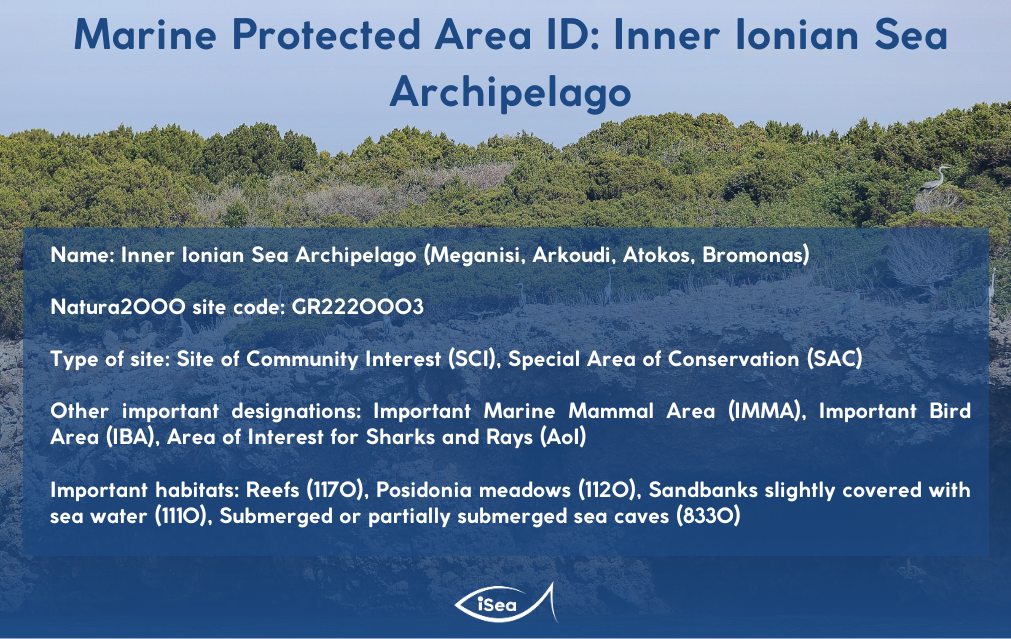
In the past, the Inner Ionian Sea Archipelago hosted an important resident population of the Endangered (EN) common dolphin, but in less than 10 years their population collapsed from 150 to zero because of overfishing of sardines (Sardina pilchardus) and the consequent collapse of the stock. Two species of sea turtles are present in the area, the loggerhead and the green turtle, while the site has been also designated as an "Important Bird Area" (IBA) and is home to several marine pelagic species such as the Yelkouan shearwater and the Scopoli's shearwater, as well as the European shag. The area was recently characterised as “Area of Interest” for sharks and rays and especially for two species of benthic sharks (Little Gulper Shark and Longnose Spurdog) and for the Endangered (EN) Spinetail Devil Ray.
Finally, the area has historically been important for the Mediterranean monk seal with its presence appearing to have increased in recent years. Monk seal monitoring in the Inner Ionian Sea Archipelago, and more specifically around Formicula by the Tethys Research Institute over the last decade has allowed to photo-identify more than 30 seals, some of them showing a strong site-fidelity being observed in several consecutive years. The condition of monk seals in the waters around Formicula is at the same time very exciting (due to the unprecedented and increasing numbers of sightings lately, including pups), but in parallel very worrisome due to disturbance caused by tourism. Like Formicula, two other uninhabited islands exist in the area, Atokos and Arkoudi which are a bit remote as well and their marine environments haven’t been studied thoroughly.
iSea aims to increase the knowledge about the biodiversity of the Inner Ionian Sea Archipelago and improve its management and the protection of threatened and protected species by the involvement of all relevant stakeholders.
Actions of 2023





You can find our past work in the area below:
You can find the project's reports below:
Collaborators
 |
 |
 |
 |
 |
 |
Funders
|
|
 |
