PRESS RELEASE
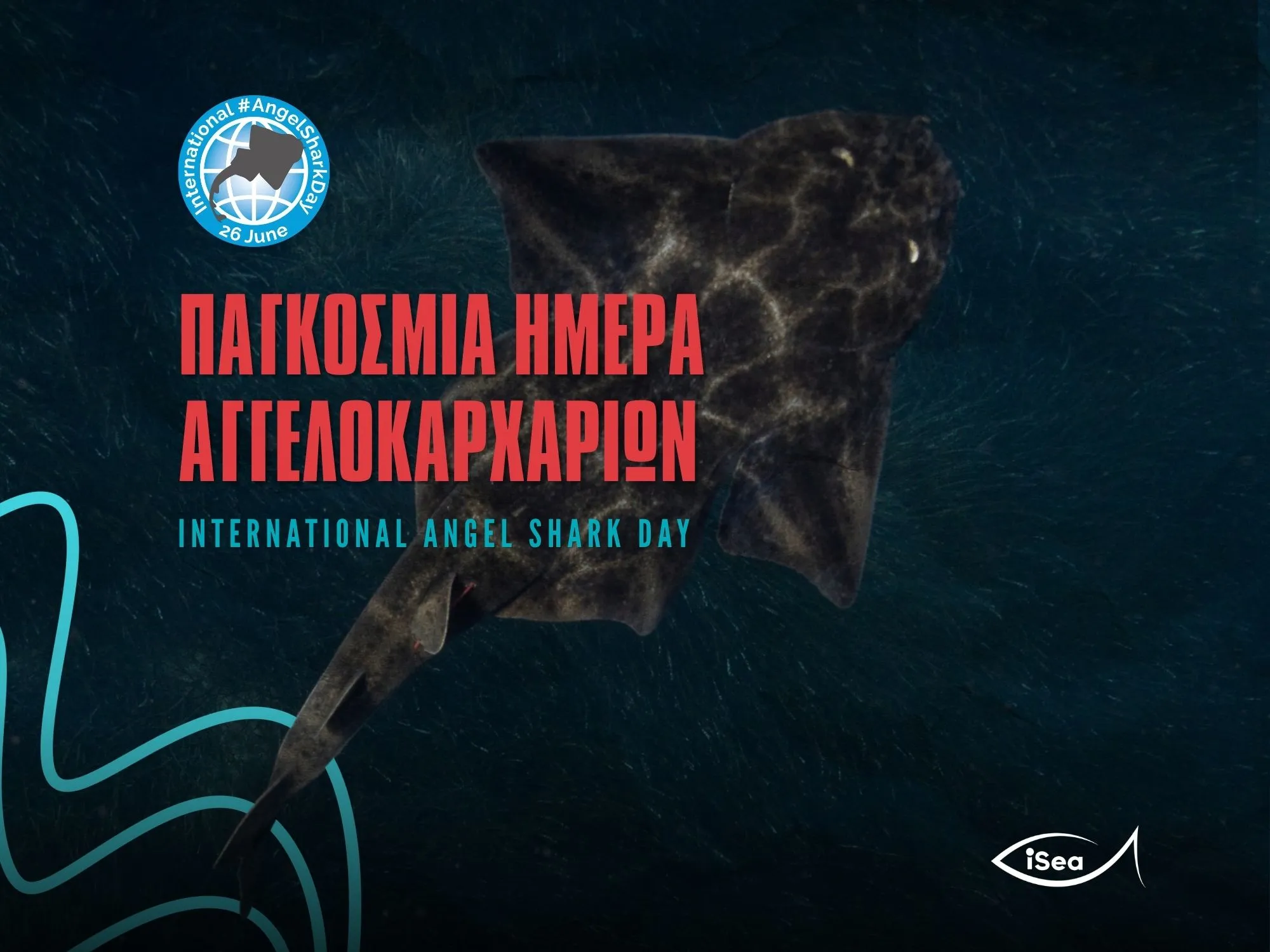
International Angel Shark Day and the steps towards their effective conservation in Greece
They look like rays, but they are sharks. They are among the most threatened shark species in the world, and until just a few years ago, almost nothing was known about them in Greece!
Today, thanks to years of dedicated work, collaboration with local fishing communities, and international partnerships, Greece is taking significant steps towards securing the future of these remarkable animals.
Since 2018, iSea is leading efforts to identify the distribution of Angel sharks and their critical habitats in Greek waters. These efforts generated invaluable new knowledge and transformed our understanding of the species in the region.
A major milestone was reached yesterday in Lemnos island, where iSea, working alongside local fishers, successfully deployed the first-ever satellite tag on an Angel shark in Greece. This achievement marks the beginning of a new chapter in αngel shark research in the country. In the coming months, data from the satellite tag are expected to provide unprecedented insights into the movements, habitat use, and behavior.
For the first time in Greece, a shark species will be studied directly in its natural environment rather than solely through fisheries-dependent research.
All this progress is considered remarkable for species whose presence in Greece was almost overlooked until 2018.
The three Angel shark species found in Greece once occurred widely across the Mediterranean Sea. Today, however, they are among the region’s most threatened marine species. Prior to 2018, fewer than ten records of Angel sharks existed in Greece. Most involved incidentally captured individuals, specimens illegally sold in fish markets under the local common name “rina,” or occasional records from fisheries dependent surveys and museum specimens.
The three species occurring in Greek waters, the Sawback angelshark (Squatina aculeata), the Smoothback angelshark (Squatina oculata), and the Angelshark (Squatina squatina), were recently assessed as Critically Endangered in the Greek Red List updated by the Natural Environment and Climate Change Agency (NECCA).
Although all three species are strictly protected under national and international legislation, they continue to be by caught and illegally traded, reflecting the urgent need for stronger conservation measures and enforcement.
As part of iSea’s ongoing efforts to improve the conservation of Angel sharks across the Mediterranean, teams from Angel Shark Project: Canary Islands and Angel Shark Project: Greece recently joined forces in Lemnos island to launch another collaboration focused on the conservation and restoration of the Critically Endangered Angel shark populations at two hotspots in the Northeast Atlantic and Mediterranean Sea: Canary Islands & Greece, which is supported by the Shark Conservation Fund.
At the same time, Angel shark research in the wider Lemnos area forms an important component of the “Reviving Lemnos” project, one of the flagship initiatives supported through the Endangered Landscapes & Seascapes Programme.
Working closely with the fishing community, researchers are collecting crucial information on Angel shark ecology and biology, helping to strengthen conservation efforts not only in Greece, but across the Mediterranean. During the field mission, the teams carried out a range of activities, including underwater visual surveys, deployment of baited remote underwater videos (BRUVs), night monitoring surveys and training in satellite-tagging techniques for Angel sharks.
Each year, the International Angel Shark Day provides an opportunity to set new conservation goals. Last year, our focus was to improve understanding of Angel shark ecology in one of Greece’s most important areas for the species: eastern Lemnos island. This year, alongside ongoing research and conservation actions, iSea will dedicate significant efforts to promoting the adoption of a National Action Plan for Angel shark conservation in Greece and become the first National Action Plan for Angel sharks anywhere in the Mediterranean making Greece a regional leader in the conservation of these unique and Critically Endangered species.
Contact Information: Ioannis Giovos, Conservation Officer, Environmental Organisation iSea, +30 2313090696, +30 6945880415 (for emergencies), info@isea.com.gr
Learn more about “Angel Shark Project: Greece” here: https://isea.com.gr/project/angel-shark-project-greece/
Find the Greek Red List here: https://redlist.necca.gov.gr/en/home-copy/
Report your Angel shark sightings here: https://angelsharksmap.zsl.org/
Learn more about “Reviving Lemnos” project here: https://www.birdlife.org/landscape-nature-restoration/lemnos-island/

