
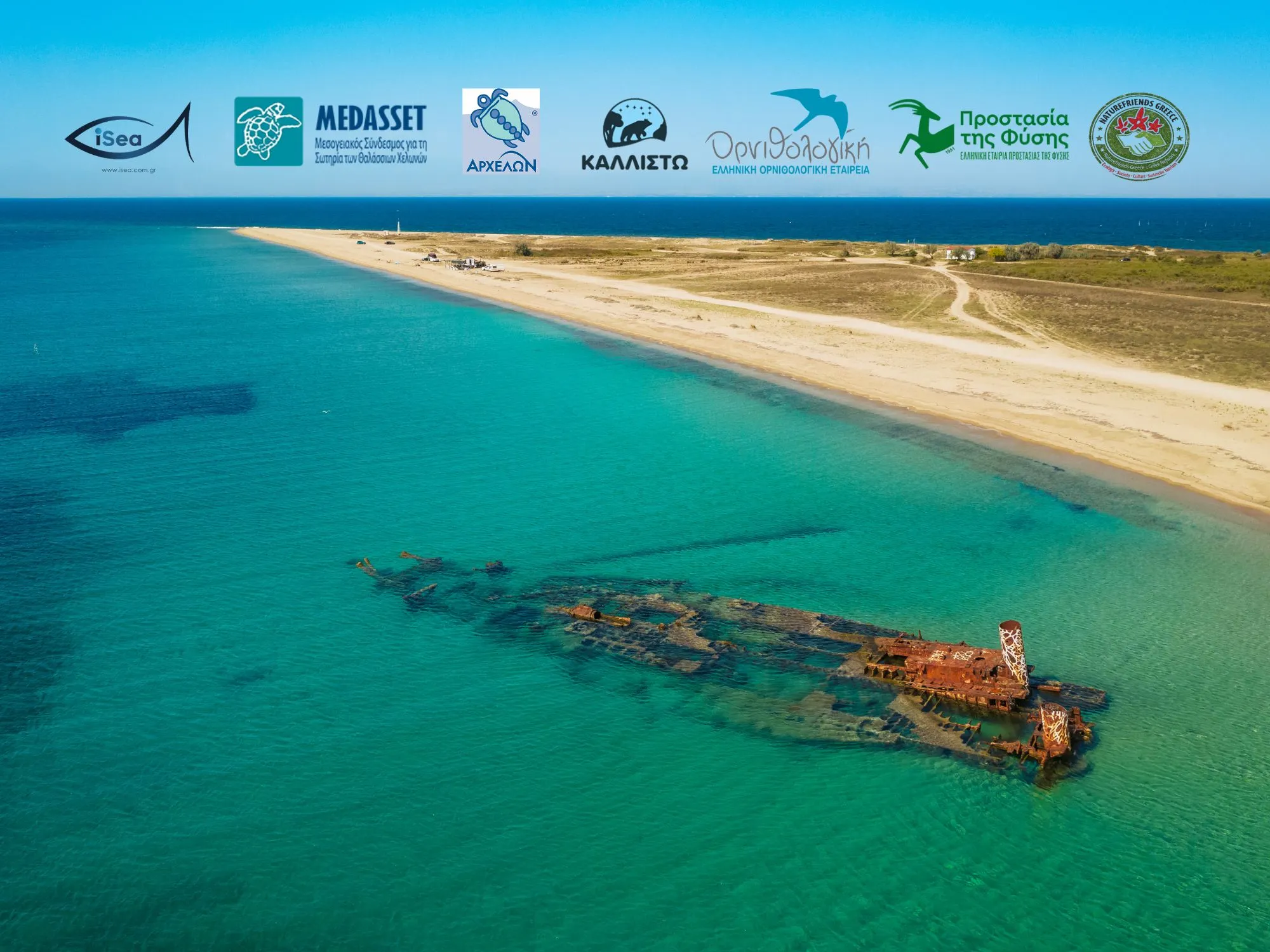
PRESS RELEASE
Why we Stand with those protesting against the Sand Extraction at Epanomi Cape
Critical questions arise regarding the impacts of sand extraction from Epanomi Cape for the construction of the 6th Pier of the Port of Thessaloniki.
We have been following with concern the recent developments regarding the planned sand extraction in Epanomi. A strong coalition of stakeholders—comprising, among others, the Municipality of Thermaikos, local residents, fishing associations, and representatives of the scientific community has expressed its opposition to the proposed sand extraction from Epanomi Cape for the construction of Pier 6 at the Port of Thessaloniki.
By Decision No. YPEN/DIPA/102946/6696/10-11-2025 of the Director General for Environmental Policy of the Ministry of Environment and Energy, entitled “Approval of the Technical Environmental Study for the Optimal Combination of Aggregate and Earth Material Transportation and the Road Transportation Plan for the Expansion Project of the 6th Pier of the Port of Thessaloniki,” provides for the extraction and maritime transport of 4,000,000 cubic meters of seabed material from the marine area of Cape Epanomi. As the decision explicitly states: “The extraction will take place from two areas. The first (~600 stremmas) had already been foreseen in the amendment of the project’s Environmental Terms Approval Decision (AEPO) by Joint Ministerial Decision 195175/7.1.2011 and will be used to a lesser extent, while the second area, located in deeper waters and at a greater distance from the coastline (3,000 stremmas), will provide the largest percentage of the materials.”
Essentially, the aforementioned decision approving the Technical Environmental Study (TEMEP) provides for the extraction of 4,000,000 cubic meters of seabed material, instead of the maximum quantity of 1,200,000 cubic meters specified in Joint Ministerial Decision No. 195175/7-1-2011, from the marine area of Epanomi Cape, and that there will be a new marine area for seabed material extraction.
This decision, in addition to the serious environmental concerns it raises, also raises questions regarding its compliance with environmental legislation, particularly Law 4014/2011. Of particular concern is the fact that, despite the existence of substantial differences regarding the project’s environmental impacts, instead of first submitting and evaluating an Environmental Impact Study and conducting the requisite public consultation and stakeholder notification process, approval was granted solely through a TEPEM.
Environmental Concerns
Although the proposed sand extraction areas are located outside the boundaries of the Epanomi Lagoon Natura 2000 Marine Protected Area and the Marine Coastal Zone, their very close proximity to it raises questions regarding the likelihood and extent to which the unique species and habitats of the protected area will be affected.
One of the area’s habitats is the Posidonia meadows. Although the sand extraction areas do not overlap with the region’s seagrass meadows, the new sand extraction site in particular is located so close to them—and without any assessment of the activity’s impact on them—that there is no guarantee they will remain unaffected.
Posidonia seagrass meadows are superior plants that form underwater forests and are our key allies in mitigating the effects of the climate crisis and preserving marine life. They are also known as the “blue lungs” of the Mediterranean, as they are among the most effective carbon dioxide sinks in the world, sequestering carbon at rates that exceed those of terrestrial forests and storing it for thousands of years. At the same time, they support significant biodiversity, including commercially important species, protect coastlines from erosion, and are vital to the livelihoods of coastal communities as a whole.
Emphasizing on the environmental impacts, Mr. Yannis Krestenitis, Professor Emeritus of Coastal Engineering and Oceanography at Aristotle University of Thessaloniki, has also expressed his views, documenting the inadequate investigation of both the coastal engineering and environmental impacts of sand extraction in the protected area of Cape Epanomi. Mr. Krestenitis raises critical questions regarding the potential impacts of sand extraction on water turbidity, the neighboring Poseidonia meadows—which constitute an EU priority habitat—the morphology of the coastline, as well as the time required for the restoration of ecological conditions and marine ecosystems following such extensive sand extraction.
The Municipality of Thermaikos’s appeal for annulment before the Council of State
The Municipality of Thermaikos has filed an application before the Council of State seeking the annulment of the decision of the Director General for Environmental Policy of the Ministry of Environment and Energy, which approved the TEPEM for the expansion project of the 6th Pier of the Port of Thessaloniki, insofar as it provides for the extraction of 4,000,000 cubic meters of sandy material from two marine areas at Cape Epanomi.
The grounds for annulment include: 1) the violation of the approved environmental terms of the existing Environmental Terms Approval Decision (AEPO), which explicitly limited extraction to 1,200,000 cubic meters from a single marine area, 2) the failure to submit a new Environmental Impact Assessment despite substantial deviations from the existing AEPO and the need for a documented assessment of environmental impacts, 3) failure to meet the legal requirements for approval through a TEPEM, 4) the absence of licensing for the marine borrow pit required for implementation of the project, and 5) the violation of Directive 92/43/EEC “on the conservation of natural habitats and of wild fauna and flora” due to the proximity of the extraction site to two Natura 2000 areas and Posidonia seagrass meadows.
As environmental organizations, we share the concerns expressed by local stakeholders and support their efforts to protect and preserve our natural heritage and both the terrestrial and marine environment—something that is not only a right, but also a responsibility of us all.
For more information:
Nefeli Konidari, Policy Officer, iSea Environmental Organisation, 2313090696, nefeli.konidari@isea.com.gr

