
PRESS RELEASE
Underneath the Surface: The Unexplored World of Sharks and Rays in Greece
Yet another scientific publication by the environmental organisation iSea that debunks the myths which continue to spark a wave of misinformation about sharks in Greece!
Although recent shark sightings in various parts of Greece have been portrayed by some as something unprecedented, scientific evidence shows that sharks have been a natural part of Greek waters for millions of years, with dozens of species having been recorded in different parts of the country. Greek waters are home to a significant number of shark and ray species which have been described since antiquity, with detailed accounts by Aristotle in his work “History of Animals”, whilst the first documented modern record dates from 1858.
Despite the spectacular increase in knowledge about sharks and rays over the last two decades, information regarding their spatial distribution remains limited, with most studies focusing on issues relating to their biology and fisheries.
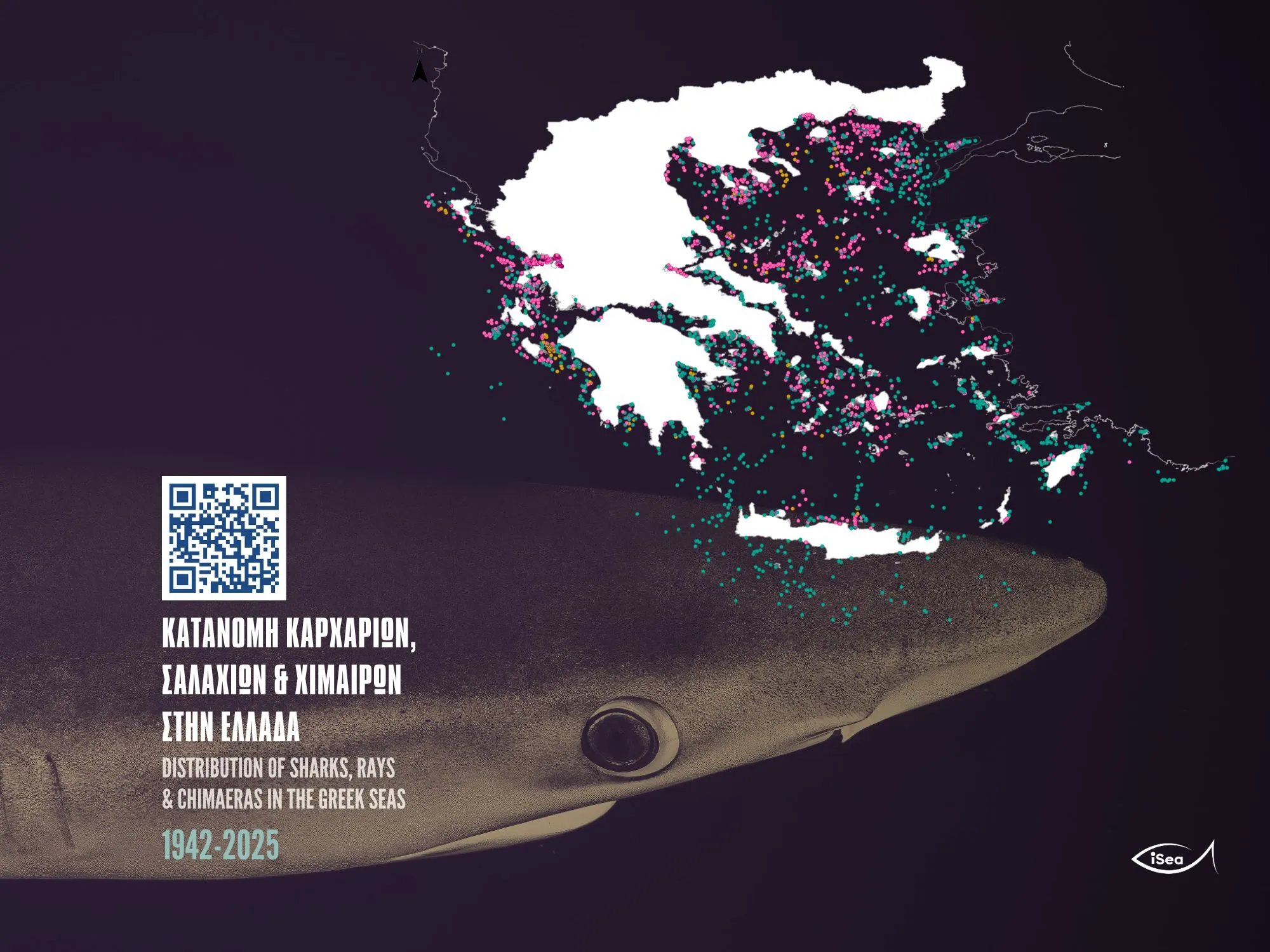
The new iSea’s study aims to bridge this knowledge gap by shedding light on the distribution of chondrichthyans (sharks, rays and chimaeras) found in Greek waters, by reviewing the available literature and historical records, combining valuable new knowledge based on scientific data collected as part of research projects run by the environmental organisation iSea since 2018, local ecological knowledge and observations from Citizen Science.
Through this, the study of a total of 5,596 available records highlights the historical presence of 62 species: 33 species of sharks, 28 species of rays and 1 species of chimaera, in different areas across the country. The most common shark species are the Smallspotted Catshark (Scyliorhinus canicula), the Common Smoothhound (Mustelus mustelus) and the Blue Shark (Prionace glauca); and, for rays, the Rough Ray (Raja radula), the Longnosed Skate (Dipturus oxyrinchus) and the Marbled Torpedo Ray (Torpedo marmorata). At the same time, several records were made of endangered species, such as the Great White Shark (Carcharodon carcharias), as well as species with a very limited distribution and for which data are scarce at a Mediterranean level, such as the White Skate (Rostroraja alba).
iSea has consistently maintained that the effective protection of sharks and rays requires measures based on reliable scientific data. For this reason, its work is not limited to generating scientific knowledge, but focuses on translating this into specific conservation policies and actions. To date, the findings of iSea’s scientific studies have been used to:
- assessing the status of species found in Greece for the Greek Red List of Threatened Species, compiled by NECCA based on the criteria of the International Union for Conservation of Nature (IUCN)
- the designation of Important Areas for Sharks and Rays in the Mediterranean
- the drafting of Action Plans for the two new National Marine Parks
- the drafting of the forthcoming National Nature Restoration Plan, which includes certain species of sharks and rays.
Further information:
Ioannis Giovos, Conservation Officer, iSea Environmental Organisation, 2313090696, 6945880415, ioannis.giovos@isea.com.gr
Read the full scientific publication on sharks, rays and chimaeras in Greece here: https://www.mdpi.com/2410-3888/11/8/492
Find out more about Greece’s sharks and rays here: https://isea.com.gr/el/download/odigos-anagnorisis-karcharion-salachion-kai-chimairon/
Find out more about their conservation status in the Greek Red List here: https://isea.com.gr/el/kokkinos-synagermos-gia-toys-karcharies-kai-ta-salachia-stin-ellada/

