
PRESS RELEASE
When night falls in the Amvrakikos Gulf
New report reveals the “secret” of Amvrakikos Gulf: illegal trawling is damaging the seabed, destroying this unique habitat and sustaining a black market at the expense of legitimate professional fishers.
The Amvrakikos Alliance is a collaborative initiative bringing together 7 organisations with a shared vision to highlight the unique ecological value and the natural and cultural heritage of the Amvrakikos Wetlands National Park, for effectively manage, restore, preserve and protect its unique ecosystems and biodiversity together with the local community.
Since its establishment in 2023, the existence of illegal fishing activities has been repeatedly reported by residents and professional fishers, who have described both the practices, the areas and the periods when these activities occur. Until now, however, all this information had remained “whispers” among locals and occasional lines in the press, when incidents were confirmed by port authorities.
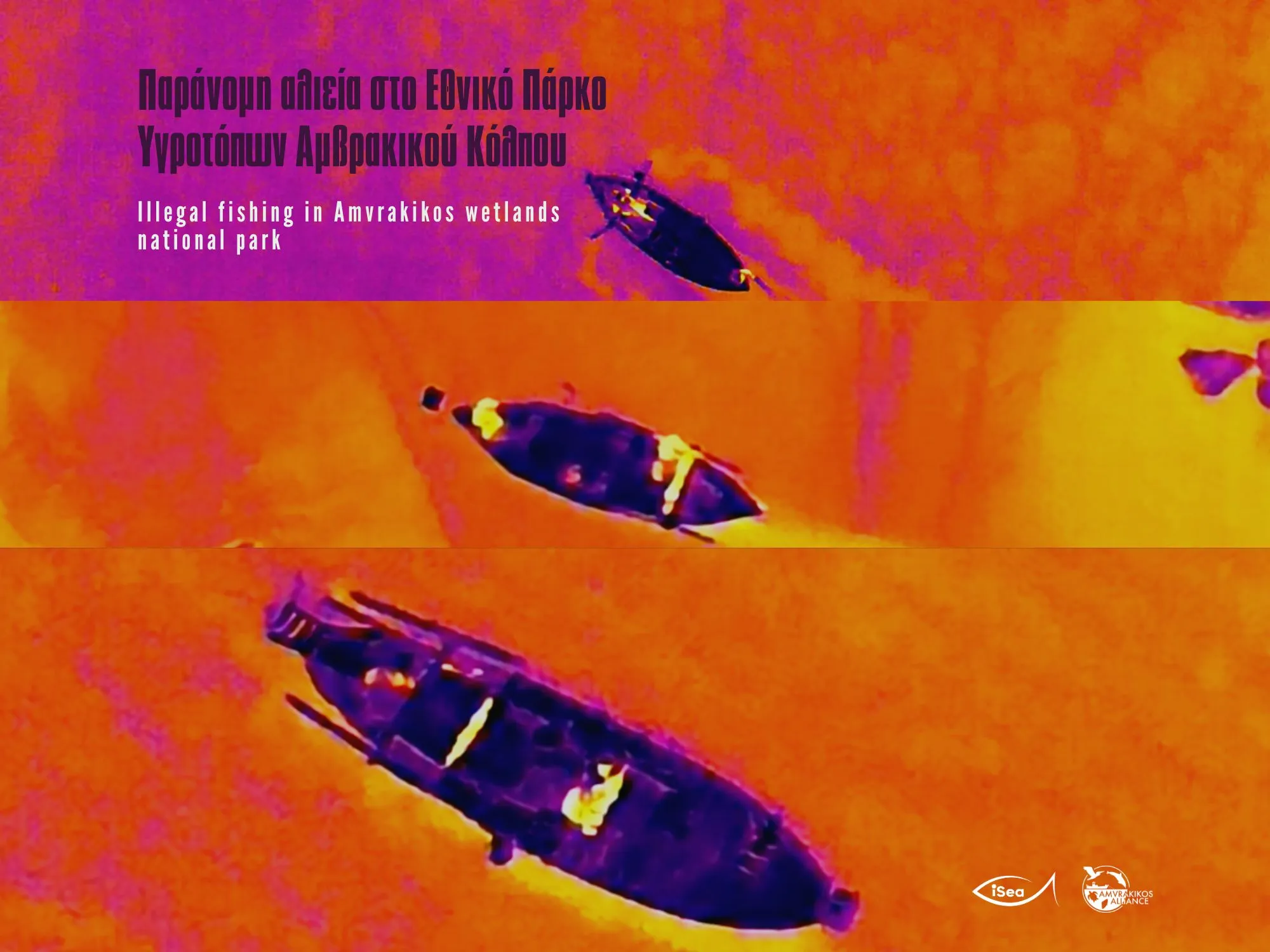
The environmental organisation iSea, through systematic monitoring of illegal fishing activities using a combination of different methods:
- monitoring through Unmanned Aerial Vehicle (UAV) and thermal cameras,
- field surveys in ports and remote mooring locations,
- information gathered through press articles and news,
- information provided directly by fishers,
documented the practices, areas and ways in which illegal fishing takes place, highlighting the need for effective enforcement of existing legislation.
According to the findings of the report “Illegal Fishing in Amvrakikos Wetlands National Park”, produced as part of the Amvrakikos Alliance, with the support of the Blue Marine Foundation, illegal fishing constitutes a significant and persistent threat to the Amvrakikos Gulf, despite the area’s protection framework and the fisheries legislative framework in force.
Nighttime monitoring focused primarily on the wider Koronisia area, where the highest number of reports of illegal incidents had been received Thus, the report provides evidence of illegal fishing, detailing the practices, locations, and timeframes, without attempting to document every single incident. Similar activities have also been reported and detected in other parts of the Gulf.
Particular attention was given to the illegal bottom trawling, which has been completely banned in the Amvrakikos Gulf since 1966, and its illegal use peaks during the fishing season for the shrimp of Amvrakikos, a well-known and important catch for the area’s traditional small-scale fishers. At the same time, the research focused on prohibited fishing gear targeting other species, such as illegal eel fishing, as well as cases in which protected species of sharks and rays are not immediately released.
According to the information collected, illegally caught fish and marine organisms, including the Amvrakikos Gulf shrimp and other species, are being traded without the required documentation, creating conditions of unfair competition and distorting the local market. Addressing this phenomenon therefore protects not only biodiversity and coastal communities, but also the local economy.
All the evidence has been submitted to the relevant national and local authorities and can serve as a baseline for coordinated and targeted inspections across the Gulf, in order to more effectively protect the National Park and provide meaningful support to legitimate professional fishers.
Based on these findings, iSea will continue to call for:
- Regular and coordinated inspections throughout the Gulf, with a greater focus on nighttime monitoring in high-risk areas
- The use of new technologies and increased controls at ports, landing sites and remote mooring locations
- Controls on the trade and distribution of seafood, with an emphasis on documentation and traceability
- A safe reporting system for investigating incidents, including the publication of aggregated data on inspections and sanctions imposed
With the aim protect the Amvrakikos Gulf and its fishers, we remain available to the authorities to provide further details regarding the methodology, findings and audiovisual material collected, in order to support the development of an effective monitoring and reporting system that will deter illegal fishing activities in the area.
Find the report on illegal fishing in Amvrakikos Wetlands National Park here: https://isea.com.gr/download/illegal-fishing-in-amvrakikos-wetlands-national-park/
More information
Ioannis Giovos, Conservation Officer, Environmental Organisation iSea, ioannis.giovos@isea.com.gr, 2313090696
A few words about Amvrakikos Alliance
Amvrakikos Gulf is one of Greece’s last refuges for large wildlife, supporting important populations of dolphins, dalmatian pelicans, sea turtles, as well as sharks and rays.
The seven organisations that make up the Amvrakikos Alliance, with the support of the Acheloos Valley and Amvrakikos Gulf Protected Areas Management Unit of the Natural Environment and Climate Change Agency (NECCA), have joined forces with a shared vision of highlighting the unique ecological value and natural and cultural heritage of the Amvrakikos Gulf.
The Alliance’s goal is to promote the more effective management, restoration and protection of the Gulf’s ecosystems and biodiversity through cooperation among the scientific community, organisations and, above all, the people who live around the Gulf.
Uniting our voices for the future of the Amvrakikos Gulf.

