
PRESS RELEASE
Arkoudi islet: Pilot Restoration of Posidonia seagrass in the Inner Ionian Archipelago
Unregulated anchoring is severely degrading Posidonia meadows in the Inner Ionian Archipelago, with the impacts particularly evident around the area’s islets.
Arkoudi, one of the uninhabited islets of the Inner Ionian Archipelago, may be known from the epic poems of Homer as a refuge of Odysseus, but today it is equally known among sailors as a popular destination for recreational vessels and yachts.
Reflecting the exceptional biodiversity of the Inner Ionian Archipelago, Arkoudi hosts a rich diversity of marine organisms and habitats. Until recently, extensive Posidonia oceanica meadows thrived around the island. Today, however, these habitats are visibly degraded, primarily due to uncontrolled anchoring by large vessels visiting the area.
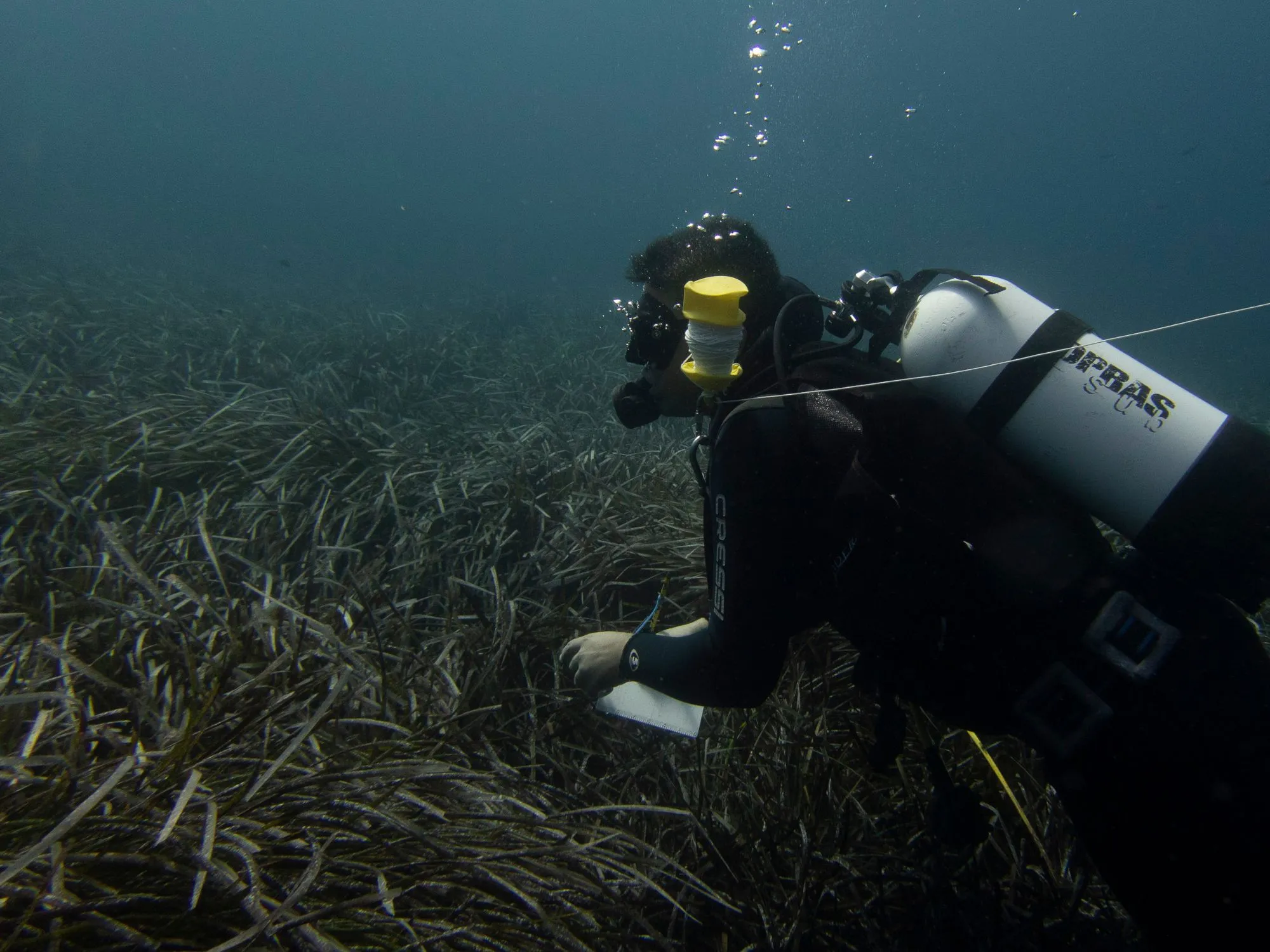
The Inner Ionian Archipelago is designated as a protected Natura 2000 site and is expected to become part of the new National Marine Park of the Ionian Sea. Nevertheless, research conducted by iSea identifies the area as one of the most heavily impacted Marine Protected Areas in Greece with regard to Posidonia meadows. Around the area’s islets, especially Atokos followed by Arkoudi, the ecological condition of the seagrass meadows was assessed as poor, while uprooted Posidonia shoots caused by anchors are clearly evident.
To support the restoration of these critical marine habitats, iSea, in collaboration with MEDSEA Foundation and Fondation de la Mer, within a broader Mediterranean initiative supported by CMA CGM Group, recently carried out a pilot transplantation initiative in the bay of Arkoudi Islet. More than 2,000 Posidonia cuttings, uprooted from Atokos and Arkoudi marine areas either by anchoring or natural causes, such as strong waves, were transplanted onto a 200 m² area of dead matte “matte morte” that once supported a thriving seagrass meadow.
The pilot action aims to actively restore the meadow and strengthen its capacity to capture and store carbon dioxide, commonly referred to as “Blue Carbon.” Beyond this, the restoration also seeks to recover the broader ecosystem services provided by healthy seagrass habitats, including their essential role as nursery grounds for commercially important marine species.
At the same time, this restoration effort directly contributes to the objectives of the EU Restoration Law and Greece’s National Restoration Plan, which support the recovery of at least 20% of Europe’s marine and coastal ecosystems by 2030.
However, the initiative marks only the beginning of a longer-term effort. Over the next three years, iSea will systematically monitor and evaluate the growth and survival of the transplanted shoots. The objective is not only to assess the effectiveness of active restoration methods, but also to optimize restoration practices and develop practical guidelines for future Posidonia restoration initiatives in the region. In this way, the project is expected to contribute valuable scientific knowledge to broader Mediterranean seagrass restoration strategies.
The project, “Pilot Restoration of Posidonia Seagrass Meadows in Arkoudi, Inner Ionian Archipelago,” represents a next step following iSea’s long-term research activities in the area. Yet the future success of the initiative also depends on the responsible behavior of the visitors.
For this reason, all vessels visiting the area are encouraged to follow best practices for Posidonia protection and to avoid anchoring on seagrass meadows.
Discover more about the area and the project here: https://isea.com.gr/project/arkoudi/
For further information:
Elektra Athinaiou
Project Manager, iSea
ilektra.athinaou@isea.com.gr

